AI Is the Future. The Opportunity Must Belong to Everyone.
Artificial intelligence is changing how people learn, work, build businesses, solve problems, and create new ideas. The most important question is no longer whether young people will encounter AI. They already do. The question is whether they will understand it deeply enough to use it with judgment, confidence, safety, and purpose.
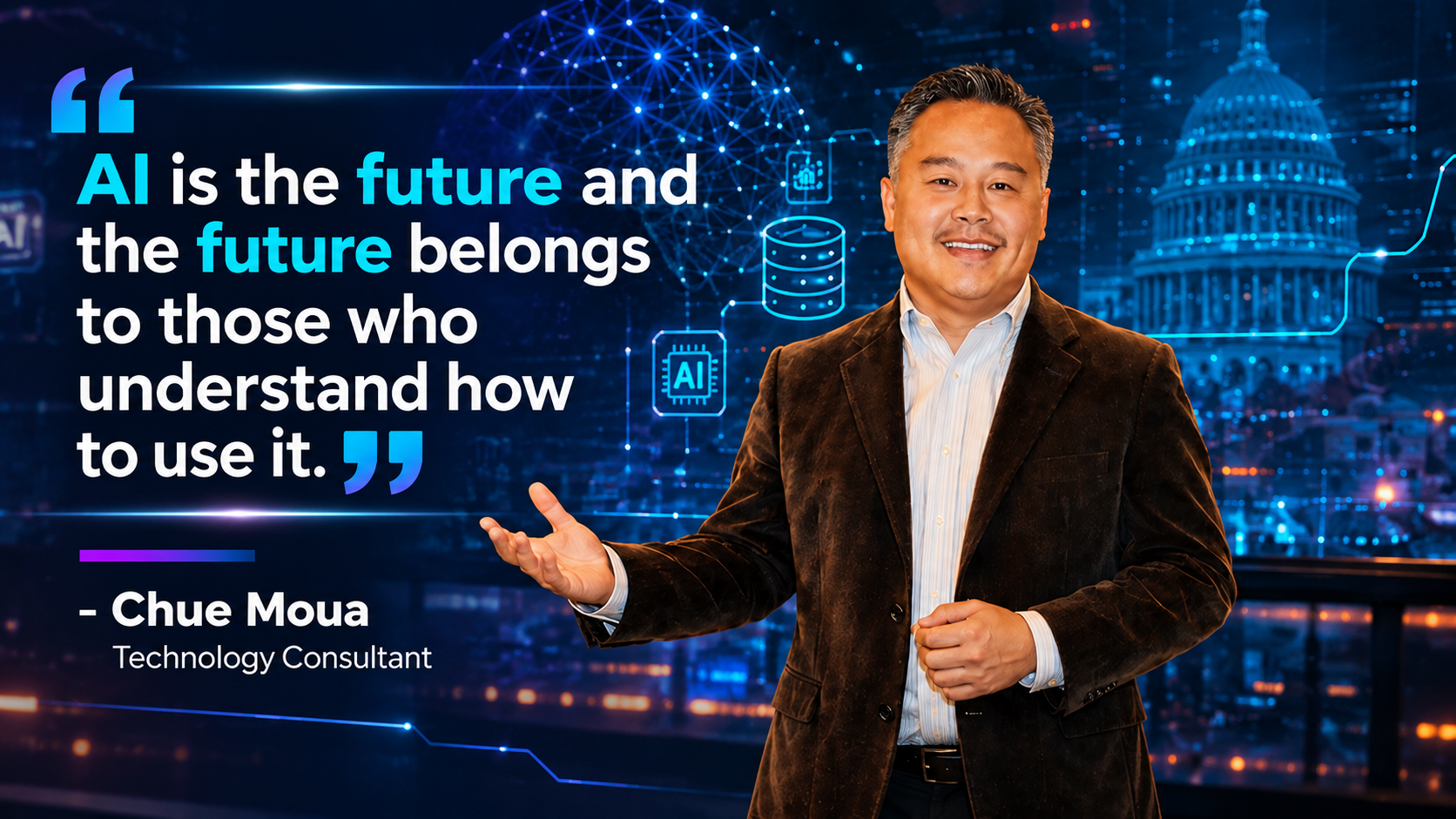
AI is the future and the future belongs to those who understand how to use it.
Access is the beginning. Capability is the goal.
Young people need more than a login to an AI tool. These six layers turn access into durable opportunity.
Opportunity Learn • Build • Lead
Why AI is different from the technology waves that came before it
AI is not only another app category. It is becoming a layer inside search, productivity software, education, customer service, cybersecurity, healthcare, finance, design, media, logistics, engineering, and software development.
It can accelerate thinking
AI can summarize, compare, organize, brainstorm, translate, simulate, and help a learner move from a blank page to a structured starting point.
It can accelerate work
People can use AI to draft, analyze, document, automate repeatable steps, create prototypes, and reduce time spent on low-value repetitive tasks.
It can lower the barrier to building
A motivated learner can move faster from an idea to a website, presentation, research plan, business concept, data analysis, or software prototype.
It changes what employers value
Knowing a tool is useful. Knowing how to frame a problem, verify output, protect data, connect tools, and produce a reliable result is far more valuable.
Using AI is not the same as understanding AI
Young people can be early adopters and still need structured training. Familiarity creates confidence; education builds competence.
A 2024 global student survey found widespread AI use in studies.
In the same survey, 58% said they did not have sufficient AI knowledge and skills.
Nearly half said they did not feel adequately prepared for an AI-enabled workplace.
EY's Gen Z research found the weakest scores in critically assessing AI and identifying its shortcomings.
It is who can turn AI into a reliable skill: defining the problem, giving useful instructions, checking the result, protecting information, improving the workflow, and producing something another person can trust.
The risk is a new kind of inequality: not just access to AI, but access to AI advantage.
AI tools may be widely visible, but meaningful participation requires more than opening a chatbot on a phone. It can require dependable broadband, a capable device, time to practice, guidance, technical confidence, safe places to experiment, and people who can explain what “good” looks like.
That matters for underserved youth because the same young person can be highly capable and highly motivated while still having fewer opportunities to convert curiosity into durable skills. A lack of access should never be mistaken for a lack of talent.
Compared with 94% among adults in households earning $100,000 or more, according to Pew's 2025 survey data.
Missing one layer can slow the path from curiosity to opportunity.
UNICEF's 2026 work on skills for an AI world specifically calls for meaningful connectivity, affordable internet, device availability, and targeted AI-skills initiatives, particularly for rural and low-income settings.
Why underserved youth should be trained in AI now—not after the labor market has already changed
The goal is not to turn every student into a machine-learning engineer. The goal is to make sure young people can participate intelligently in a world where AI becomes part of ordinary work.
AI literacy can become a force multiplier
A student with strong judgment and modest resources can use AI to research faster, practice communication, explore unfamiliar careers, learn technical concepts, and turn ideas into prototypes.
Early exposure builds confidence before opportunity arrives
Internship applications, college projects, entry-level roles, entrepreneurship, and community leadership become easier to approach when AI is already a familiar working tool rather than something mysterious.
Training replaces passive consumption with active creation
The shift from watching, scrolling, and asking isolated questions to designing, testing, building, documenting, and presenting projects changes a young person's relationship with technology.
Critical AI skills protect young people from bad information
AI systems can be confidently wrong. Students need the habit of checking sources, identifying uncertainty, recognizing bias, separating evidence from generated language, and knowing when a human expert is required.
Privacy and security must be learned before risky habits form
Young people should know not to paste passwords, private records, confidential school or employer information, financial data, or other sensitive content into tools without understanding how the service handles that data.
Communities benefit when local talent becomes local capability
Students who learn to automate, analyze, design, communicate, and build can apply those skills to small businesses, nonprofits, schools, family businesses, neighborhood problems, and future startups.
What it really means to understand how to use AI
Prompting matters, but real AI literacy is a system of connected skills. A young person should learn how to move from a problem to a trustworthy outcome.
Define the problem before asking the model
Clarify the goal, audience, constraints, context, expected format, and definition of a good result.
Give clear instructions and useful context
Learn iterative prompting, role and audience context, examples, structured outputs, follow-up questions, and refinement.
Verify facts, logic, assumptions, and sources
Never confuse fluent language with truth. Compare sources, test claims, inspect calculations, and challenge uncertain output.
Turn one prompt into a repeatable workflow
Combine research, drafting, analysis, spreadsheets, documents, images, code, and automation into an end-to-end process.
Use AI with privacy, security, ethics, and attribution in mind
Know what data is safe to share, when permission is required, how bias can affect outcomes, and where human accountability remains essential.
Create evidence of skill
Finish real projects, document what was learned, explain the decisions, show before-and-after improvement, and build a portfolio that demonstrates capability.
The transformation we want to create
AI education is most valuable when it changes what a young person believes they are capable of producing.
AI skills can travel with a young person into almost any field
The opportunity is larger than “getting an AI job.” AI can become a multiplier inside careers that already matter to young people.
Research, code assistance, testing, documentation, threat analysis, automation.
Market research, proposals, customer workflows, forecasting, process design.
Ideation, storyboards, editing support, visual concepts, content systems.
Learning, administrative support, research assistance, workflow improvement—with appropriate privacy and professional controls.
Policy research, communication, public-service workflows, data organization, civic problem solving.
Tutoring support, lesson planning, study systems, practice, accessibility, knowledge organization.
Talent is everywhere. Access, training, mentorship, and opportunity are not.
AI Technology Avenue exists to help close that distance. We want young people—especially those from underserved backgrounds—to see AI as something they can understand, direct, build with, question, and use to create opportunity.
The mission is not to teach shortcuts. It is to teach leverage. Students should leave with stronger thinking, stronger digital judgment, practical projects, and a clearer picture of how technology can connect to their future.
Devices, connectivity, tools, orientation, and a safe environment for hands-on learning.
Capabilities, limitations, prompting, verification, bias, safety, privacy, and responsible use.
Use AI to research, design, automate, communicate, analyze, and produce something tangible.
Mentors help students understand quality, tradeoffs, career expectations, and professional habits.
Document projects, decisions, iterations, outcomes, and the student's role in creating them.
College, certifications, internships, careers, entrepreneurship, community projects, and continued learning.
Teach power and responsibility together
AI supports decisions; it does not remove responsibility for decisions.
Important facts, citations, calculations, and claims deserve independent checking.
Students should recognize sensitive information before it ever enters a prompt.
AI should expand a student's thinking and output, not erase their learning process.
Projects should consider usefulness, accessibility, safety, and the people affected by the result.
Tools will change. Durable skills—curiosity, critical thinking, communication, and adaptability—will travel farther.
The opportunity is real. So are the readiness and access gaps.
These sources are useful starting points for understanding youth AI use, AI literacy, workforce readiness, connectivity, and equitable access. Statistics describe the cited populations and should not be generalized beyond their study designs.
Pew Research Center — Americans and AI by age
Among U.S. adults ages 18–29, 61% said they ever use ChatGPT in a February 2026 survey.
View research ↗Digital Education Council — AI in Higher Education Global Survey 2026
The survey reports that most student and faculty AI-literacy profiles remain at beginner to intermediate levels; only 29% of students said instructors were well equipped to guide AI use.
View research ↗Digital Education Council — Global AI Student Survey
86% reported using AI in their studies, while 58% said they lacked sufficient AI knowledge and skills and 48% felt unprepared for an AI-enabled workplace.
View research ↗EY — AI literacy among Gen Z
EY's international Gen Z study found stronger scores for recognizing AI use than for prompting and critical assessment, highlighting the need for deeper literacy training.
View research ↗Pew Research Center — Digital divides in the U.S.
54% of adults in households earning under $30,000 reported home broadband, compared with 94% among those earning $100,000 or more.
View research ↗UNICEF Innocenti — Skills for an AI World
UNICEF calls for meaningful connectivity, affordable internet, device availability, and skills initiatives grounded in local realities, especially in rural and low-income settings.
View research ↗AI education for young people: common questions
Does every young person need to learn how to code?
No. Coding can be valuable, but AI literacy is broader: problem framing, prompting, critical evaluation, data awareness, workflow design, privacy, security, ethics, communication, and the ability to create useful outcomes. Different students can apply those skills in different careers.
Why focus on underserved youth if many AI tools are available for free?
Free access to a tool does not automatically provide a capable device, reliable broadband, structured curriculum, professional examples, mentorship, project feedback, or a pathway to translate practice into education and employment. Equity requires attention to the full learning environment.
Should students rely on AI for schoolwork?
AI should support learning rather than replace it. Students should follow school policies, disclose or cite AI use when required, verify important outputs, do their own thinking, and use AI to deepen understanding rather than simply generate an answer.
What is the most important AI skill?
There is no single skill. Strong AI users combine clear problem definition, effective instructions, critical thinking, verification, domain knowledge, communication, and responsible handling of information.
Can AI training really improve economic mobility?
Training alone cannot solve structural inequality. But practical AI and digital skills can expand a young person's ability to learn, create, demonstrate capability, participate in modern workflows, and pursue opportunities that increasingly expect digital fluency. The strongest programs pair skills with access, mentoring, projects, networks, and pathways.